Here is the first article in the Music Product Academy series where we map the journey of a pro audio product from its initial spark through market intelligence, 1-day AI validation sprints, and business case gatekeeping.
Introduction
When musicians, hardware engineers, or founders talk about launching a new pro audio product, the conversation almost always starts with technology:
“Let’s build a new audio interface.”
“We need a better wireless microphone.”
“What if we build a pedal that does X?”
“We can write a much better DSP algorithm.”
In the professional audio industry, technology is only a fraction of the equation. A commercial audio product does not begin with a circuit board or an algorithm; it begins with understanding who needs it, what operational problem it solves, why a customer would spend their capital on it, and how the entire system must perform to deliver that value reliably on stage, in the studio, or across a broadcast facility.
This is where Product Management and System Engineering intersect to transform an idea into a shipping, revenue-generating product line.
1. The Eight Catalysts of Pro Audio Product Birth
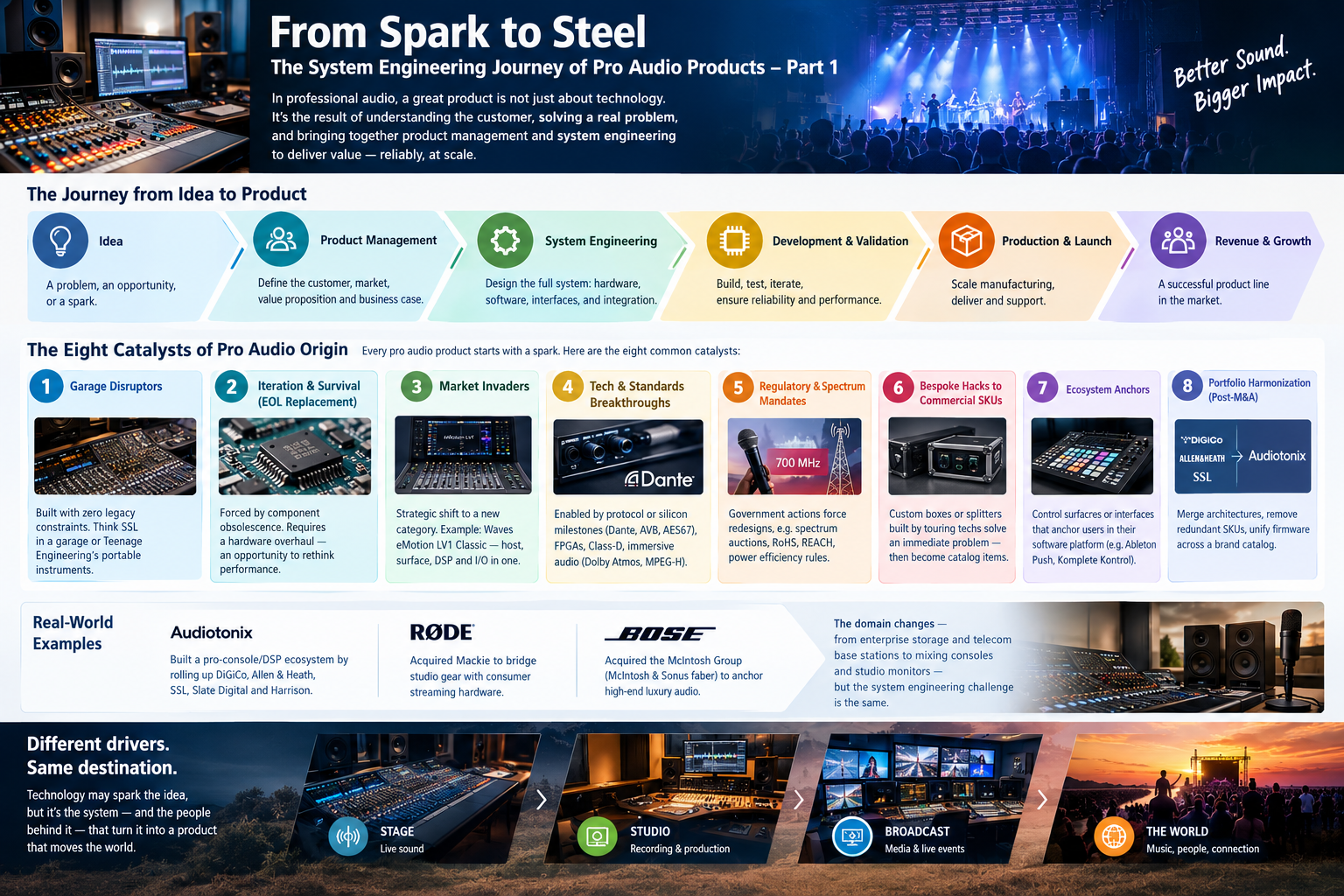
Every piece of audio hardware or integrated software starts with a spark. In professional audio, products typically originate from eight distinct catalysts:
- The Garage Disruptor: Built with zero legacy hardware constraints. Think of early Solid State Logic (SSL) reimagining console signal flow in a garage, or Teenage Engineering rethinking electronic instruments as portable, highly aesthetic design objects.
- Iteration & Survival (EOL Replacement): Forced by component obsolescence. When primary silicon, software or hardware components reach End-of-Life (EOL), manufacturers must overhaul the hardware architecture just to maintain production, creating an opportunity to rethink performance from the ground up. In my case all of the Waves hosts and servers reach this point.
- The Market Invader: A strategic shift to conquer a new product category. For years, Waves Audio maintained a highly successful modular live ecosystem—decoupled SoundGrid DSP servers, networked stageboxes, and touch-screen software hosts. To capture the unified live digital console market, the company made a strategic shift: consolidate the host computer, tactile surface, DSP engine, and local I/O into a single physical chassis—the eMotion LV1 Classic: https://www.waves.com/mixers-racks/emotion-lv1
- Technology & Standard Breakthroughs: Enabled by protocol or silicon milestones, such as IP audio networking (Dante, AVB, AES67), high-density FPGAs, Class-D power amplification, or immersive spatial audio rendering engines (Dolby Atmos, MPEG-H).
- Regulatory & Spectrum Mandates: Government actions that force immediate hardware redesigns, such as telecom spectrum auctions (600/700 MHz) invalidating legacy wireless microphones, or environmental mandates (RoHS, REACH, power efficiency rules).
- Bespoke Hacks to Commercial SKUs: Custom utility boxes, switchers, or passive splitters built by touring system techs to solve an immediate problem on a stadium tour that gain widespread industry demand and transition into mass-produced catalog items.
- Ecosystem Expansion & Hardware Anchors: Dedicated control surfaces or interfaces built by DAW developers (like Ableton Push or Native Instruments Komplete Kontrol) to anchor users inside their software platform.
- Portfolio Harmonization (Post-M&A): If you’ve lived through major tech consolidations—like watching Floware and BreezeCOM merge into Alvarion back in the wireless telecom days, or EMC getting absorbed into Dell—you know this operational drill inside out. Engineering teams are forced to merge wildly disparate hardware architectures, kill off redundant SKUs, and streamline firmware across a unified brand catalog.
The exact same playbook is driving pro audio today:
- Audiotonix built a massive pro-console/DSP ecosystem by rolling up DiGiCo, Allen & Heath, Solid State Logic, Slate Digital, and Harrison.
- RØDE acquired Mackie to bridge studio gear with consumer streaming hardware.
- Bose acquired the McIntosh Group (McIntosh & Sonus faber) to anchor high-end luxury audio.
The domain changes—from enterprise storage and telecom base stations to mixing consoles and studio monitors—but the underlying system engineering challenge is identical.
2. Vetting the Market: Real Audio Intel vs. Blind Faith
A product idea requires belief, but blind faith without validation is one of the fastest ways to burn capital. In business, selecting your market means selecting your fate; there are no small products, only small or non-existent markets.
While enterprise tech companies rely on broad IT frameworks like the Gartner Magic Quadrant, those tools do not cover live sound mixing desks, studio converters, or stage hardware. Pro audio product managers and system engineers rely on specialised intelligence:
- Futuresource Consulting: Quantitative deep dives into global market shares, unit volumes, and revenue distributions across live sound, broadcast, and recording.
https://www.futuresource-consulting.com
- NAMM Global Reports: Macro-level tracking of long-term industry performance, retail trends, and category growth.
https://www.namm.org/membership/industry-insights
- SAR Insight & Consulting: Silicon-level intelligence tracking audio DSPs, SoC platforms, ADC/DAC converter trends, and wireless audio protocols.
- Direct Field Intelligence: Direct conversations with major production and rental houses (such as Clair Global or Solotech), festival crews, and broadcast techs. Tracking what gear is actively loading onto trucks versus sitting in warehouses reveals true market demand.
- Competitive Teardowns & Target BOM Calculations: Purchasing competitor units, tearing them down component by component, and estimating their Bill of Materials (BOM) cost to determine if your proposed concept can be built profitably. Is it right to say: One of the projects I enjoyed most, the guitar multi-effect was buried at this stage.
- Try tool developed by Tzipi Schindler that helps teams have conversations about tech debt, or rather product debt. Next month we will go deeper on subject.
https://github.com/tzipischindler/elevate-devex-metric-discovery
3. The 1-Day AI Validation Protocol
Validating a product idea historically took months of market research. Modern product teams can compress this initial validation cycle into a single, structured 16-hour sprint using specialized AI agent pipelines:
- Step 1: Founder-Market Fit Alignment: An AI agent analyzes your engineering team’s exact technical competencies, industry contacts, and background to identify where you possess immediate context without a 6-month learning curve.
- Step 2: Market Trajectory Analysis: An analyst agent audited by strict rules (every metric must have a verifiable source) evaluates whether the target market has grown over 5–10 years, whether it is downturn-resilient, and whether emerging technology will empower or obsolete the hardware.
- Step 3: Forum Pain Mining (JTBD): A research agent scrapes user forums, field service logs, and marketplace reviews to extract recurring “Jobs to Be Done” and operational frustrations (e.g., thermal failures under outdoor festival heat or tedious setup times during 15-minute stage changeovers).
- Step 4: The Ruthless Red-Team: An isolated AI opponent agent is instructed to tear the product concept to pieces, exposing weak financial assumptions, physical oversights, or unverified market claims.
- Step 5: The “Mom Test” Customer Interviews: Conducting 3–4 short interviews with target users. Instead of asking if they would buy the proposed product, ask exclusively about past behavior: “When did this problem last happen, how did you solve it, and what did that workaround cost you?”
- Step 6: Micro-Budget Smoke Test: Using LLM coding tools (like Claude Code) to build a single-page landing site featuring the exact user pain quotes. Drive targeted traffic to measure hard intent (clicks, form sign-ups, pre-order inquiries).
4. The Business Case Gatekeeper
Sitting squarely between initial concept validation and the drafting of the Market Requirements Document (MRD) is the Business Case. This document serves as the formal financial and operational gatekeeper for executive leadership.
[ Idea & AI Validation ] ──> [ BUSINESS CASE ] ──> [ MRD ] │
Financial Constraints
• Target MSRP vs. BOM Ratio
• NRE Tooling & Compliance
• 18–24 Month Break-Even
Risk & Impact
• Thermal & RF Hazards
• Supply Chain EOL Limits
• Clear Kill-Switch Gates
The Multiplier Rule in Pro Audio Hardware
To ensure profitability across dealer networks, distribution tiers, warranty reserves, and R&D amortization, retail MSRP is strictly tied to the manufactured Bill of Materials (BOM) cost by a multiplier (typically 3.5 to 5):

If a target console MSRP is established at $6,000 and business margins require a 4 multiplier, the total hardware BOM (components, PCBs, chassis, power supply, packaging) cannot exceed $1,500.
Risk Assessment & Exit Strategies
A thorough business case establishes explicit “kill switches” before committing capital:
- Exit Strategy (Gate 1 Exit): If post-DVT compliance testing reveals structural thermal failures requiring a full chassis redesign that inflates Non-Recurring Engineering (NRE) costs beyond 130% of budget, the hardware build is terminated or reverted before mass production tooling starts.
- Thermal & RF Hazards: Identifying high-power DSP dissipation and high-speed digital bus emissions early.
- Supply Chain Risks: Mapping pin-compatible secondary sources for critical AD/DA converters or SoCs to avoid single-source dependencies with 26+ week lead times.
Join the Conversation
We have mapped the journey of a pro audio product from its initial spark through market intelligence, 1-day AI validation sprints, business case gatekeeping
Where do you see the biggest friction points in your own development process? Have you experienced project ideas failure in this stage?
Share your thoughts, experiences, or questions.
In the next article of the Music Product Academy series, we will cross the critical bridge: How to translate a validated product concept into clear, unambiguous MRD.