AI hype has made many people dream of running small businesses that can provide financial stability, without the need for large teams and businesses run by agents. Larger companies also analyse how to augment their processes and business models so they can stay competitive. This article shares insights and thoughts from my own experiences and experiments on how to go from individual agents to company-wide AI adoption.
Can people build AI agents?
Can people in your organisation build agents, and do they know how to use them? This may sound funny but how can you build an AI-native company if your employees do not have basic skills – creating a harness. So what I would recommend is to start by giving workshops to at least a number of employees who can disseminate the knowledge later.
That is why we created our online course – Building Your First AI Agent for Product Work
Do we share the same context?
What would happen if you share different strategies and conflicting goals with your employees? Or when you share different versions of the same procedure?
People will get very confused. The same goes with AI agents. They will provide consistent results only if they have the same context files – the right harness.
At Audio Product Academy, I have created a strategic context repository with key context: vision, roadmap, customer personas, product list with pricing. Each time we create a new assistant or update one, context dispatch Python scripts upload/update relevant .memory files.
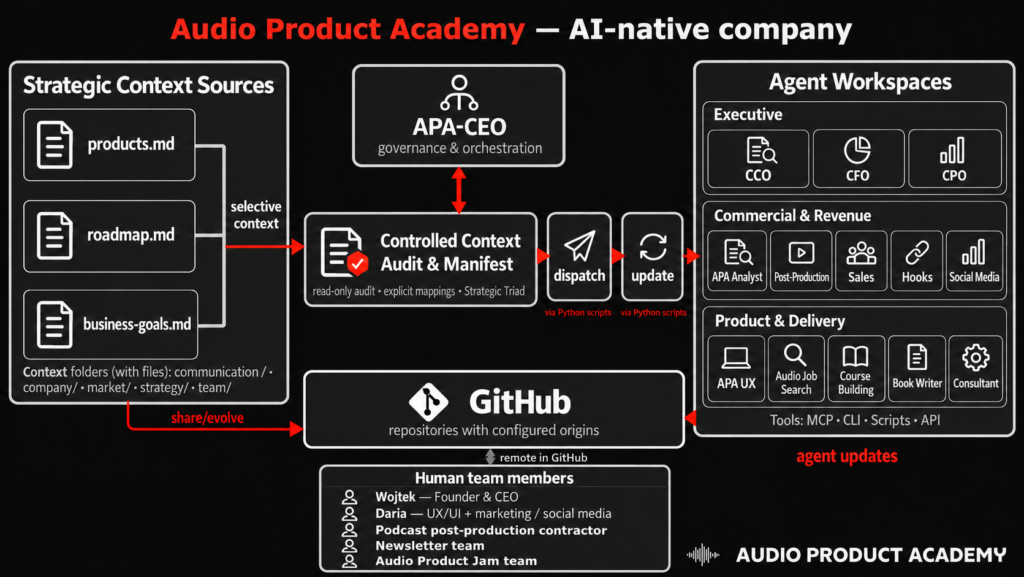
Figure 1 – Context dispatch system
Currently, business versions of Anthropic and OpenAI subscriptions (Claude Team or GPT Business) offer company-wide skills and connectors. This way, you can create rules followed by everyone and restrict certain files from being edited by team members.
Make sure your agents are connected
Claude has become very popular as it provides a very stable connection, especially to Microsoft apps, which is weird as OpenAI is closely connected to Microsoft. Maybe it is because Anthropic created MCP – the protocol that enables natural language communication with third-party tools. Currently, both Anthropic and OpenAI offer easy integration with Microsoft and many popular tools like Figma, Canva, HubSpot, and many others.
It is also very surprising that Google, which already has a major ecosystem of apps like Google Docs, Google Drive, Google Sheets did not build a more advanced ecosystem around the Antigravity app and Antigravity IDE.
Common long-term memory for agents to learn
Good practice is to maintain a decision log in the agent’s memory folder, so whenever important decisions are made, they can be retrieved by your agent beyond a specific session.
How can you share the memory and work that has been done with your agent with your other team members?
We have been recently experimenting with Tomasz, who created a database where at the end of each session, our agents save decisions that were made, so we don’t have to always communicate vertically between ourselves, but I can also ask his agent what decisions he made and why.
Communication – don’t fall into AI Silos
Having shared memory doesn’t solve all the problems. It is good to also integrate agents into standard communication channels like Slack, MS Teams, or to use open-source applications like Open Agents.
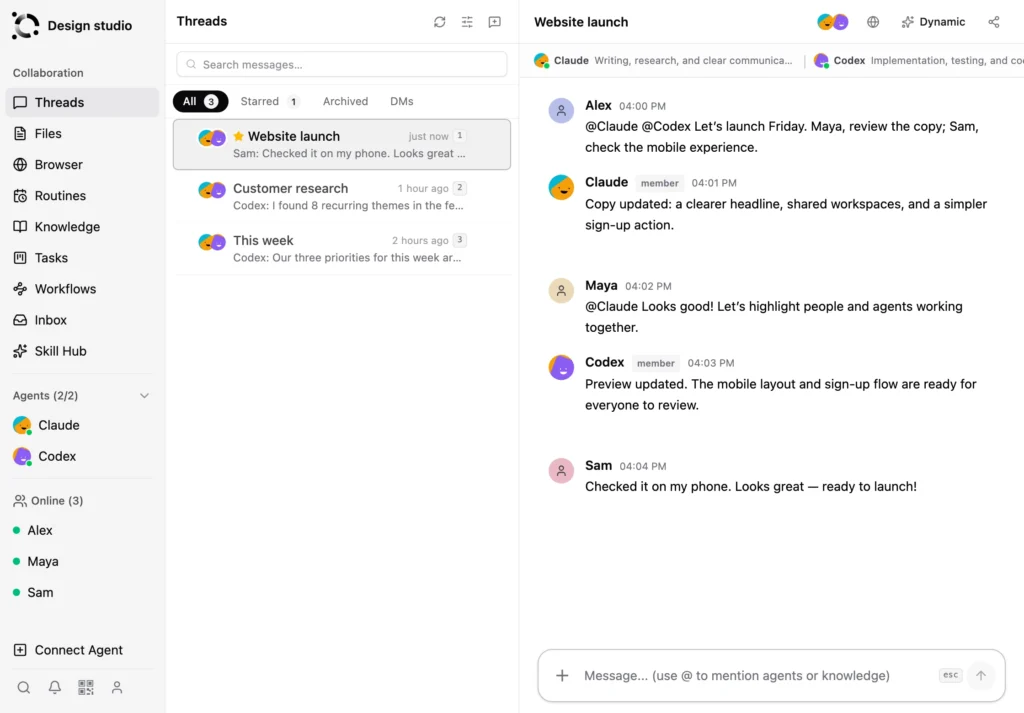
Figure 2 – Open Agents
How autonomous can the agents be?
I haven’t reached a state where I can allow my agents to work completely autonomously with 0 or close to 0 supervision. Very often, it’s not the agentic workflow itself that’s the problem, but unstable MCP servers, renewing API tokens, etc. AI is a probabilistic tool so sometimes prompts get executed completely automatically and other times they ask me for approval. Therefore, it is important to
- include guardrails- code-based safety mechanisms (hooks) that control your AI processes
- regularly test your AI workflows using something we call AI Evals – where you build a golden dataset (human) and compare AI performance against this golden data using various KPIs
The question is, do we really need a fully autonomous company?
AI implementation is a question of ROI: where can it deliver the biggest value? Some domains, like marketing communication, you can’t fully delegate to AI anyway, because it cannot capture the nuances of human communication. Some tasks, especially the creative ones, we do because we like them – so why automate them?
Security is a bigger issue than you think
Some AI fanboys created a very harmful narrative that you don’t need to have any IT skills to create AI workflows and we don’t need software people anymore. At the same time, we heard stories where AI was able to work around specific safety mechanisms. We have experienced this ourselves firsthand. So you need to be able to maintain your AI tools the same way you support your IT infrastructure. You need at least basic knowledge of IT for that.
Summary
It is really puzzling that so many companies buy subscriptions and think that AI transformation will happen magically. They end up spending hundreds of thousands on tokens and on unstructured experiments.
What you really need is someone who can help you implement AI, build the harness, rules and skills. It can be an IT department that has the AI skills. It can be an AI implementation partner like our Augmented Pipelines.
You may not be the biggest fan of AI, but it’s not going anywhere. So the only question remains: how will we use it?
We also organise the only industry workshop, AI-Powered Teams for people who interested in going beyond personal assistants to the real AI-augmented processes and team works https://team.ai-augmented.pm/
Thanks for reading – written 100% by a human.